
Why You Can’t Relax: How an Overactive Nervous System Drives Anxiety
You’ve tried the breathing exercises. You’ve downloaded the apps. Perhaps you’ve even Googled “how to stop overthinking” at 11pm while your shoulders sit somewhere around your ears.
And still, your body won’t switch off.
Here is the thing nobody tells you: anxiety isn’t just something that happens in your head. It happens in your jaw, your neck, the headache that arrives every Sunday afternoon, and the stomach that clenches the second you check your emails.
For a lot of people, the endless loop of advice (breathe more, sleep better, think differently) doesn’t stick because it never reaches the actual problem. It addresses the output without touching the input. That input, for some people, starts at the very top of the spine, in the upper cervical.

When the Nervous System Won’t Stand Down
Your nervous system was built to constantly read your environment. When your brain detects danger, whether a car swerving into your lane or a looming deadline, it triggers the sympathetic nervous system, flooding the body with cortisol and adrenaline. Heart rate climbs, palms get clammy, and breathing shortens. This is useful, because in a genuine emergency, it can save your life.
The trouble is that the nervous system wasn’t designed for the kind of low-grade, never-quite-resolving stress that most of us live with. It also can’t reliably tell the difference between a physical threat and a social one. Worrying about a difficult conversation produces many of the same physiological responses as actual danger. The alarm gets triggered. And sometimes it just doesn’t stop.
When that stays chronic, the body settles into a kind of permanent low-level bracing. The parasympathetic system, the one responsible for calming everything back down, keeps getting overridden. Not because anything is wrong with it exactly, but because the signal telling it to stand down never comes.
What That Actually Feels Like
Most people know what anxiety feels like mentally – the circular thinking, the what-ifs. What catches people off guard is how much of it shows up physically in the body.
Tension & Headaches
- The Shoulders & Neck: Muscle tension is nearly universal in people with chronic anxiety, and the neck and shoulders take the worst of it. When the stress response fires, muscles contract to brace for action. When it never fully switches off, that contraction stops being a reaction and starts being a resting state. People walk around at 70% tension for so long they stop noticing.
- Anxiety Headaches: Cortisol and adrenaline cause blood vessels to constrict and the muscles around the scalp and neck to tighten. Do that day after day and you get the familiar dull, band-like pressure across the forehead or at the base of the skull. A nervous system stuck in a heightened state also has a lower pain threshold, which is part of why the headaches keep coming even on days that don’t feel particularly stressful.
The Gut, Brain & Sleep
- The Gut: The gut is another one people often don’t connect back to anxiety. The vagus nerve runs a direct line between the brainstem and the digestive system, and digestion is one of the first things the body deprioritises when the sympathetic system takes over. Bloating, nausea, and urgency often follow.
- The Mind: Anxiety increases activity in the amygdala, the brain’s threat-detection area, while dialling down the prefrontal cortex. The part that reasons gets quieter; the part that scans for danger gets louder. Circular, unstoppable thinking is a brain running in the wrong mode because the nervous system told it to.
- Sleep: Poor sleep makes all of the above worse. An overstimulated nervous system blocks the shift into genuine rest. You wake up already depleted, making the nervous system more reactive the next day.
These things feed each other in ways that make them very hard to address one at a time. Tight muscles signal threat to the brain. The brain keeps the stress response going. The stress response keeps the muscles tight. No amount of technique reliably breaks that if the underlying driver is still running.
The Part of the Spine Most People Have Never Considered
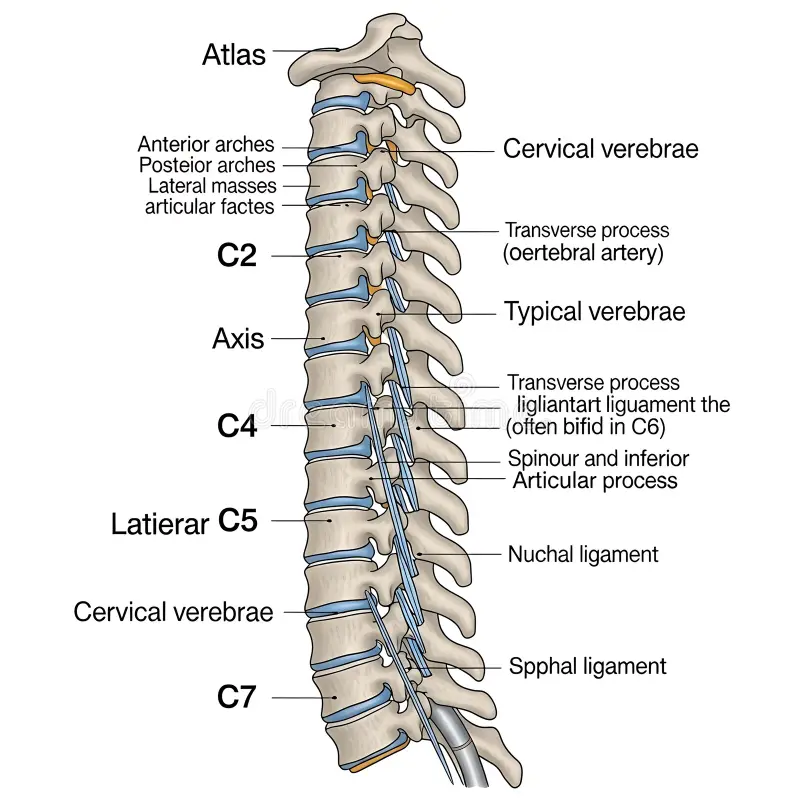
Two vertebrae at the very top of your spine, the atlas (C1) and axis (C2), sit directly around the brainstem. Most people have never thought about this. The brainstem is where the stress response is regulated. It controls heart rate, blood pressure, breathing, and the balance between the sympathetic and parasympathetic systems. It’s where the body physically decides between fight-or-flight and rest-and-digest.
Running through this same region is the vagus nerve. It travels from the brainstem all the way down into the heart, lungs, and gut. It is the primary pathway for the parasympathetic system’s calming signal. Healthy vagal tone – meaning how well the vagus nerve is actually functioning – is one of the strongest predictors of how resilient someone is to stress. When the nerve is compressed or irritated, that resilience drops.
A 2019 review published in Frontiers in Neurology found that dysfunction in the cervical spine can push the autonomic nervous system towards increased sympathetic activity. A structural restriction or altered alignment at C1 or C2, even a small one, can keep the brainstem operating under constant low-level interference. The nervous system gets stuck in a pattern it can’t self-correct out of, not because anything is broken, but because the structural conditions for calm have never quite been met.
Research demonstrates that adjustments directed to the upper neck produce measurable parasympathetic responses, including reduced heart rate and lower blood pressure. Which raises an obvious question: how many people are managing anxiety without ever having had the top of their spine looked at properly?
What a Precise Upper Cervical Adjustment Does
Upper cervical chiropractic is its own specialised discipline. It isn’t the same as general chiropractic, and it bears very little resemblance to what most people picture when they hear the word “chiropractic.”
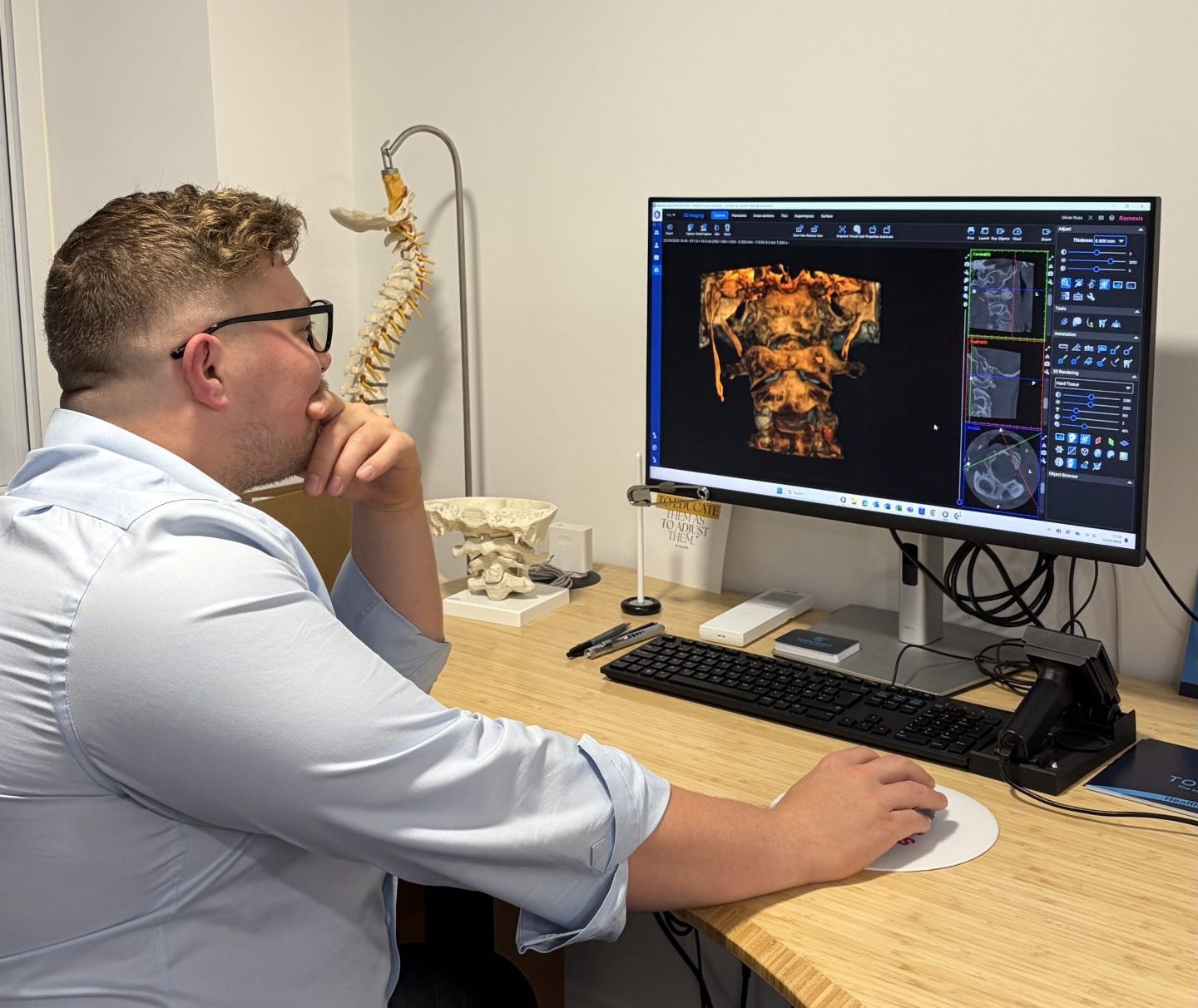
The focus is specifically on the atlas and axis. Before anything is adjusted, precise imaging (such as 3D CBCT) is used to identify exactly how the vertebrae have shifted, sometimes fractions of a degree. The adjustment itself is gentle, often nothing more than a light contact at the side of the neck. No twisting, no forceful rotation. Most people are surprised by how little they feel during it.
What happens afterwards is where it gets interesting.
Studies measuring heart rate variability before and after spinal adjustments have found consistent improvements. HRV is one of the most reliable markers of how well the autonomic nervous system is functioning, and higher HRV is associated with both lower anxiety and better capacity to recover from stress.
A study in the Journal of Alternative and Complementary Medicine found reduced cortisol in chiropractic clients after a series of adjustments. A pilot study in the Journal of Upper Cervical Chiropractic Research reported improvements in stress levels, sleep, and general wellbeing. Furthermore, research on tension-type headaches has found that spinal adjustments reduced both headache frequency and associated anxiety.
What clients often describe beyond the physical changes is harder to put numbers on – a sense of the body finally letting its guard down, of being able to take a full breath. People who’ve been tightly wound for years sometimes find it difficult to explain what’s different. Only that something has shifted.
What Helps Between Visits
The adjustment works at the structural level. Clients who actively support their nervous system between visits tend to hold the correction better.
-
Mechanistic Breathing: Slow, diaphragmatic breathing with a longer exhale than inhale is key. The extended exhale directly stimulates the vagus nerve, telling the parasympathetic system to activate. Five minutes a day done consistently over several weeks actually shifts the nervous system’s resting baseline, measurably improving HRV.
-
Daily Movement: Walking, stretching, and anything that interrupts long static periods helps. Accumulated tension doesn’t release on its own.
-
Sleep Regularity: An inconsistent sleep schedule leaves the nervous system more reactive the following day. The system doesn’t regulate well when it’s already running depleted.
-
Caffeine Control: If baseline anxiety is high, caffeine is worth an honest look. It directly raises sympathetic activation. While you don’t need to cut it entirely, it’s worth knowing it adds to the physical load.
The Piece Most Anxiety Conversations Miss
There’s no shortage of advice for anxiety. Therapy, medication, breathwork, cold exposure, journaling – some of it genuinely helps. But a lot of people do all of it and still feel like their body is lagging behind. Like the mind has got there, but the nervous system hasn’t caught up.
When the structure around the brainstem and vagus nerve has a joint restriction or altered alignment, there’s a continuous source of interference in the system. The nervous system tries to regulate and something physical keeps pulling it back. Cognitive tools work at the level of thought; they can’t reach a structural problem.
Upper cervical care isn’t a cure for anxiety, and it doesn’t claim to be. What it does is support the spine to remove physical interference that may have been quietly working against you. It gives the nervous system the structural conditions it needs to do what it was always designed to do.
If your shoulders are still up around your ears, the headaches keep coming back, and your anxiety won’t settle however hard you try, it may be worth finding out whether the top of your neck has ever been properly looked at.
Disclaimer : If you are experiencing persistent anxiety symptoms, please speak with your GP or a qualified mental health professional. Upper cervical chiropractic care focuses on spinal health and nervous system function; it is a complementary approach and not a substitute for medical or psychological advice.
References
- Budgell, B. S. (2000). Reflex effects of subluxation: The autonomic nervous system. Journal of Manipulative and Physiological Therapeutics, 23(2), 104–106.
- Henderson, C. N. R. (2019). The role of the cervical spine in autonomic nervous system regulation. Frontiers in Neurology, 10, 445.
- Zhang, Y., et al. (2021). Vagus nerve stimulation and its role in modulating stress and anxiety. Frontiers in Psychiatry, 12, 664322.
- Elster, E. L. (2015). Upper cervical chiropractic care and quality of life in patients with chronic health conditions: A pilot study. Journal of Upper Cervical Chiropractic Research, (1), 13–23.
- Nolet, P. S., et al. (2021). Neurobiological basis of chiropractic manipulative treatment of the spine in the care of major depression. Acta Biomedica, 92(1).
- Harvard Health Publishing. (2024). Recognizing and easing the physical symptoms of anxiety.
- Liv Hospital. (2026). Generalised anxiety disorder symptoms and behavioural signs.