
What is ADHD? Symptoms, Care Options, and More
Does your child have trouble paying attention, sitting still, or controlling their impulses? If so, you’re not alone. An estimated 5% of children in the UK have ADHD. Studies suggest that in England, around 618,000 to 740,000 children and young people (aged 0–24) live with ADHD. This includes many undiagnosed cases. While around 3-5% of children have the condition, only a portion have a formal, recorded diagnosis. These cases are rising significantly.
ADHD can make daily life feel like an uphill battle. It impacts everything from academic performance and social relationships to self-esteem and family dynamics. But what if there was more to the story than just a deficit or disorder? What if we look closely at the underlying function of the nervous system? By supporting physical well-being and providing the right lifestyle care, we can help these incredible kids unlock their full potential.
In this article, we’ll explore the neurological basis of body regulation. We will also introduce a supportive approach to maximising physical strengths. Whether you’re a parent searching for answers or an adult living with ADHD, get ready to discover a new perspective on health.
What is ADHD?
Attention Deficit Hyperactivity Disorder (ADHD) is a neurodevelopmental condition. It is characterised by persistent patterns of inattention, hyperactivity, and impulsivity that interfere with daily functioning and development.
All children can be inattentive, hyperactive, or impulsive at times. However, those with ADHD exhibit these behaviors more severely and frequently. These traits are also often not appropriate for their age.
The primary signs of ADHD in children include:
-
Inattention: Difficulty sustaining focus, following instructions, and organising tasks. They may be easily distracted, often lose things, appear forgetful, or not listen when spoken to directly.
-
Hyperactivity: Constantly fidgeting, tapping, or squirming. They have trouble sitting still, talk excessively, and always seem “on the go” as if driven by a motor.
-
Impulsivity: Blurting out answers, interrupting others, and having difficulty waiting their turn. They frequently act without thinking through the consequences.
These signs can manifest differently depending on the type of ADHD an individual has:
| ADHD Type | Primary Characteristics |
| Predominantly Inattentive Type | Difficulties primarily involve paying attention and organisation (formerly known as ADD). |
| Predominantly Hyperactive-Impulsive Type | These signs mainly involve excessive movement and impulsive actions. |
| Combined Type | Significant manifestations of both inattention and hyperactivity-impulsivity. |
If you’re concerned that your child might have ADHD, know that you’re not alone. Millions of parents worldwide face similar challenges daily, and there is hope. By understanding how the whole body interacts with the nervous system, you can help your child thrive.
Exploring the Neurological Landscape
While the current diagnostic process is helpful for identifying ADHD, it has some limitations. Relying solely on symptom checklists fails to capture the underlying neurological function.
At Top Chiropractic, we believe that an in-depth consultation and comprehensive neurological exam are essential for accurately identifying how your child’s body is processing information. By assessing brain and nervous system function, regulation, and sensorimotor integration, we can identify specific physical areas of imbalance. This allows us to develop a targeted plan for overall wellness.
Without a thorough assessment, these underlying spinal and neurological physical tensions may be missed. To understand how chiropractic care can support a child’s overall well-being, we first need to examine the role of the nervous system in regulation.
The Role of the Autonomic Nervous System (ANS)
The Two System Branches
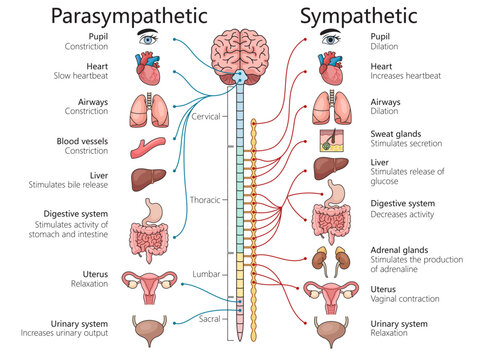
At the core of our health is the autonomic nervous system (ANS). The ANS controls all of our body’s unconscious functions, from digestion and heart rate to immune response and stress regulation.
The ANS has two main branches:
-
The Sympathetic Nervous System (SNS): This drives the “fight, flight, or freeze” response. It kicks in when we perceive a threat or challenge.
-
The Parasympathetic Nervous System (PNS): This drives the “rest, digest, and regulate” response. It helps us relax and recover.
In a healthy nervous system, these two branches work together in balance. This allows us to respond appropriately to our environment and return to calm when stress passes.
Understanding Body Imbalance
However, in many children, this natural balance is disrupted. A combination of prenatal stress, birth trauma, and developmental challenges can lead to a state of chronic sympathetic dominance. The “gas pedal” of the SNS gets stuck on high, while the “brake pedal” of the PNS weakens.
At the heart of this spinal and nervous system dysfunction is a phenomenon known as a subluxation. This means a structural misalignment causing nerve interference and imbalance. Over time, this physical stress can lead to dysautonomia. This is a state where the ANS can no longer regulate itself effectively. This imbalance can have far-reaching effects on digestion, immune function, mood, and cognitive performance.

Supporting Your Child’s Well-being
If you’re reading this, chances are you know firsthand the challenges and triumphs of loving a child with ADHD. You’ve seen their struggles, strengths, frustrations, and resilience. You have likely tried everything in your power to help them thrive in a world that doesn’t always understand their unique wiring.
At Top Chiropractic, we want you to know that you’re not alone. By looking at a child’s health through a neurological lens and addressing spinal dysfunction, we help families support their overall vitality.
Our approach is gentle, drug-free, and customised to each child’s unique physical needs. Gentle, specific chiropractic adjustments help support spinal health so the nervous system can adapt and regulate more effectively. This supports clearer communication between the brain and body.
Important Note on Our Role: We want to be entirely clear: we are not treating ADHD or ADD. Instead, we are helping the body function at its absolute best. This supports the nervous system so children can naturally reach their full physical potential.
Schedule a FREE Discovery Call here
Reference
- Amjad, I., Imran Khan Niazi, Kumari, N., Duehr, J., Gulyana Shehzad, Rashid, U., Duehr, J., Trager, R.J., Holt, K. and Haavik, H. (2024). The effects of chiropractic adjustment on inattention, hyperactivity, and impulsivity in children with attention deficit hyperactivity disorder: a pilot RCT. Frontiers in psychology, [online] 15. doi:https://doi.org/10.3389/fpsyg.2024.1323397.