
You have tried the dark room. The ice pack. The tablets. Cancelling plans, again. And still the migraines come back. What if the problem is not in your head, but in the bones just below it?
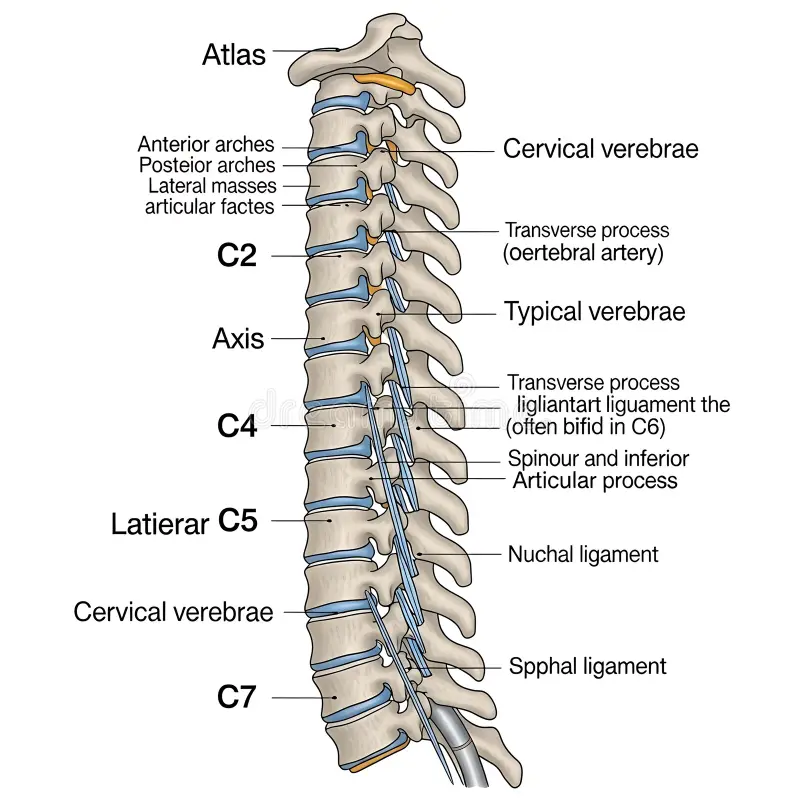
There is a growing body of research pointing to misalignment of the top bones in the neck as a factor in the migraine symptom picture. Specifically, the atlas (C1) and axis (C2), the first and second bones of the spine, sit in a region of the body that has a direct influence on brain blood flow, fluid pressure, nerve function, and pain. When these bones shift out of position, the effects can be wide-ranging and long-lasting.
Important note: Upper cervical chiropractors do not claim to treat migraines or any medical condition. What we assess and correct is structural misalignment of the upper neck. When that alignment is restored, the body is better placed to regulate its own function.

The Top of the Neck: Why This Area Is So Important
The atlas (C1) is the first bone of the spine. It sits directly under the skull and has no disc above or below it. It is a ring-shaped bone that allows your head to nod. The axis (C2) sits just below it and has a small upward peg that fits inside the atlas. Together they allow most of the rotation in your neck.
What makes this area so important is not just how it moves, but what lives inside and around it. This small region contains:
- The brainstem, which controls breathing, heart rate, blood pressure, and most of the body’s automatic functions
- The vertebral arteries, which carry up to 20% of the brain’s blood supply
- The pathway for cerebrospinal fluid, the protective fluid that surrounds the brain and spinal cord
- The suboccipital muscles, which are some of the most nerve-dense muscles in the entire body
- The upper part of the trigeminal nerve system, which is the main pain pathway for the head and face
When the atlas or axis shifts even slightly from its normal position, it can negatively affect any of these structures. The result is not usually one isolated symptom. It tends to be a collection of them.
Blood Flow: When the Brain Does Not Get Enough
One of the clearest links between the upper neck and migraines is the disruption of blood flow. The two vertebral arteries travel up through small holes in the side of each cervical vertebra before entering the skull. At the level of the atlas, they make a wide curve outward before passing through the base of the skull into the brain.
This curved section is one of the most vulnerable parts of the artery’s journey. When the atlas is misaligned, this section of the artery can be stretched or compressed. Research published in the Journal of Upper Cervical Chiropractic Research has shown that blood flow velocity inside the skull can change following an atlas correction.
A study by Flanagan (2015) proposed that structural problems at the junction where the skull meets the neck can reduce both the flow of blood into the brain and the drainage of blood back out. This creates a state of increased pressure inside the skull that is closely linked to how migraines begin.
Flanagan MF. The role of the craniocervical junction in craniospinal hydrodynamics and neurodegenerative conditions. Neurology Research International. 2015.
What Happens When Blood Flow to the Brain Falls?
The brain is extremely sensitive to changes in blood supply. Even small reductions, particularly to the back of the brain where vision is processed, can cause:
- A wave of electrical overactivity in the brain, which is the starting point for a migraine attack
- Activation of the trigeminal nerve system, the main source of migraine-type head pain
- Increased sensitivity to light, sound, and touch
- Changes in how the brain processes and blocks pain signals
Hadjikhani et al. (2001) used brain imaging to record this wave of activity happening in real time during a migraine aura. What the upper cervical research adds to this is a structural reason for why that wave might be happening in the first place.
Hadjikhani N, et al. Mechanisms of migraine aura revealed by functional MRI in human visual cortex. Proc Natl Acad Sci USA. 2001;98(8):4687-4692.
Fluid Pressure: The Squeeze You Cannot See
What Is Cerebrospinal Fluid?
Cerebrospinal fluid, or CSF, is a clear fluid that surrounds and protects the brain and spinal cord. It acts as a cushion, carries nutrients, and removes waste products. It moves through the brain and down the spine in a slow, rhythmic pulse, roughly eight to twelve times a minute.
The narrowest point in the entire CSF pathway is right where the skull meets the top of the neck. This junction is called the craniocervical junction (where C1 and C2 is). Because this is the tightest part of the route, any structural change in this area has a knock-on effect on CSF movement throughout the entire nervous system.
How an Atlas Misalignment Affects Fluid Flow
When the atlas shifts backward or rotates out of its normal position, the back of the bone can crowd into the space at the base of the skull. This reduces the opening through which CSF flows between the brain and the spinal canal.
When that flow is restricted, pressure inside the skull can rise. Flanagan’s research described this process in detail, explaining how the buildup of pressure irritates the pain-sensitive lining of the brain (the meninges), activates the trigeminal nerve, and produces the deep, throbbing head pain that people with migraines know well.
A study by Alperin et al. used MRI scanning to measure both CSF and blood flow at the craniocervical junction and found that structural changes in this area produce clear, measurable differences in how fluid moves through the brain.
Alperin N, Hushek SG, Lee SH, Sivaramakrishnan A, Lichtor T. MRI study of cerebral blood flow and CSF flow dynamics in an upright posture. Acta Neurochir Suppl. 2005;95:177-181.
That pressure at the back of your head. The fullness behind your eyes. The pounding that gets worse when you lean forward or lie down. These are consistent with what happens when CSF flow is restricted at the top of the neck.
Upper cervical chiropractic focuses on restoring this vital alignment to allow your body to regulate its own pressure and flow. Finding out the cause is where real change begins.
Ready to find the missing piece? Book your consultation today.
Note: This is Part 1 of a 2-part series on the Migraine-Neck connection. Once you finish reading about blood flow and pressure below, you can click here to read Part 2 about Migraine Auras and Muscle Tension.