
The New Gold Standard
Since the inception of Chiropractic, clinical imaging has been a vital part of a detailed patient examination. X-rays have been the Chiropractor’s “go-to” modality for years, offering many clinical advantages. In recent years, MRI has also found its use in specific soft tissue cases.
However, in the upper cervical world, X-ray has been the most prevalent imaging type as it was-until recently-the best way to assess alignment at the upper cervical spine and ensure patient safety by screening for pathologies. But there is now a new gold standard for upper cervical imaging: Cone Beam Computed Tomography (CBCT).
The Technology of the Future
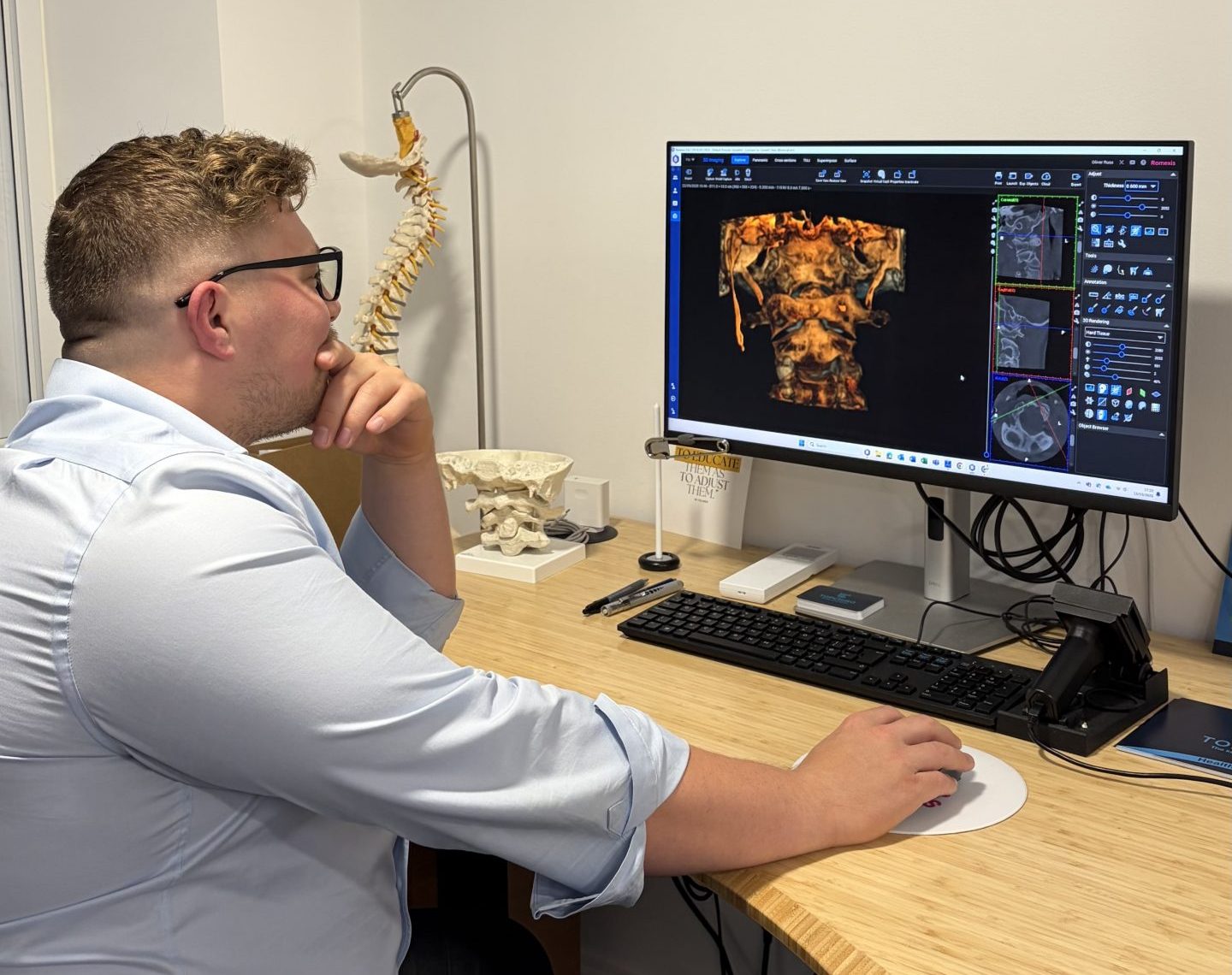
Cone Beam Computed Tomography (CBCT) is a form of 3D imaging that uses a cone-shaped X-ray beam and a rotating detector to capture detailed volumetric images of skeletal structures. Unlike traditional CT, which uses multiple helical slices, CBCT acquires the entire region in one rotation, providing high-resolution 3D visualisation with much lower radiation exposure¹.
CBCT was first introduced in the late 1990s for dental/maxillofacial imaging and has since become increasingly adopted in chiropractic for visualising the upper cervical spine, craniocervical junction, and other key osseous structures².
Why Chiropractors Use CBCT
CBCT offers chiropractors unprecedented structural clarity of the spine -especially the craniocervical junction, including the atlas (C1) and axis (C2). It allows for assessment of upper cervical misalignments, including rotation, tilt, and translation patterns not visible on 2D X-ray³.
The Structural Advantage
Chiropractors use CBCT for evaluating traumatic or non-traumatic instability (CCI), particularly at C1-C2⁴, and chronic neck pain evaluation when subtle bony abnormalities require high detail visualisation⁴. This allows for highly specific, evidence-based chiropractic adjustments.
Precision Meets Patient Safety
CBCT’s ability to image in weight-bearing positions, including flexion/extension or rotational stress views, provides functional data unseen in standard CT or X-ray⁴.
- Lower Radiation vs. Medical CT: CBCT delivers significantly less radiation than traditional medical CT (which delivers 10-20x more dose). Radiation for upper cervical CBCT can be equal to or less than comparable radiographic series used in chiropractic care²,⁵.
- Higher Image Accuracy than 2D X-ray: Eliminates structural overlap and distortion; provides thousands of viewing angles for precise measurement; enables evaluation of complex anatomy (e.g., C1-C2 relationship)⁶.
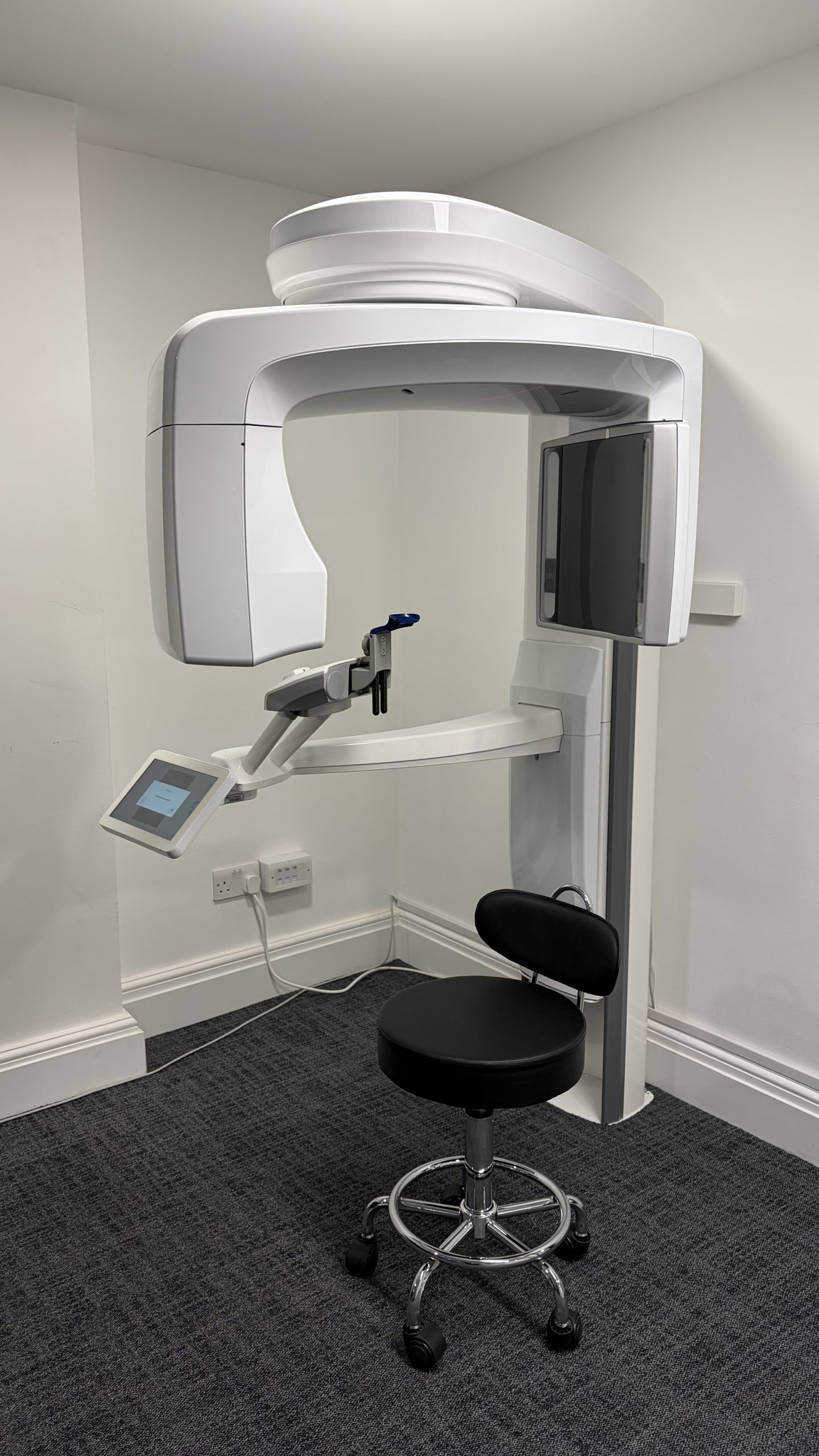
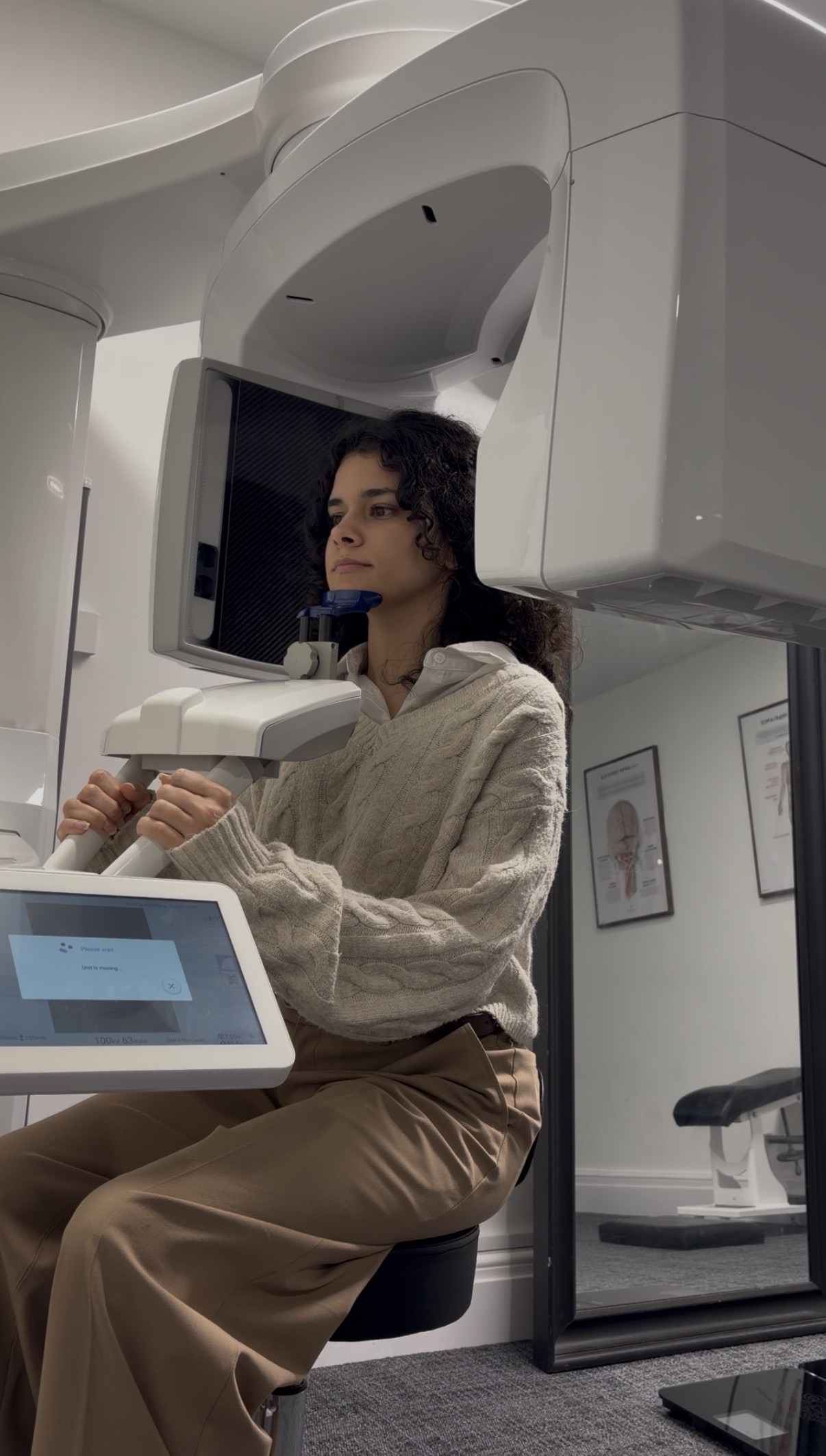
- Faster, Comfortable, Single-Rotation Scan: Most CBCT scans take 20-60 seconds and are performed standing or seated, using a simple upright unit².
- Detailed 3D Visualisation: Multiplanar reconstruction (axial, coronal, sagittal), 3D volumetric models, and custom slicing allow Chiropractors to inspect anatomy from any direction, revealing issues not visible on standard X-ray².
Radiation Risks and Considerations
While CBCT uses lower radiation than traditional CT, it still uses ionising radiation. Radiation from CBCT gives equivalent to around 6-30 days of natural background radiation, depending on scan region and machine⁷. (A typical CT scan of the same area gives about the same background radiation that you would get in 63 to 154 days⁷). The radiation exposure for our CBCT unit at its highest resolution (150 micron) ranges between 48 and 91 micro sieverts. This is comparable to a long-haul flight (e.g., London to Singapore) which exposes you to around 70-100 µSv.
Precision at Top Chiropractic
At Top Chiropractic, we use these detailed 3D baseline images to monitor progress over time, re-evaluating after care if clinically indicated³. By focusing on the craniocervical junction with this level of detail, we ensure appropriate justification, region-specific collimation (limiting field of view), and minimised repeat scans.
If you think our approach may be right for you or if you want to find out more, why not book a complimentary 15 min call with one of our Chiropractors.
References
- Scholten, J., Kos, A., Richardson, M., & Campion, K. (2023). Cone Beam Computed Tomography: Technology overview, dose, and utility considerations for chiropractors and regulatory bodies. JCC. 6(1): 92-99.
- Evans, T., & Scholten, J. (No Date). CBCT. Life Chiropractic College West.
- Rising Tide Chiropractic. (2021). Cone Beam Computed Tomography (CBCT). Rising Tide Chiropractic.
- Demetrious, J. (2025). Cone Beam CT of the Upper Cervical Spine: Indications and Utilisation in Chiropractic. Postgrad DC.
- DeNunzio, G., Evans, T., Beebe, M, E., Browning, J., & Koivisto, J. (2022). Craniocervical Junction Visalization and Radiation Dose Consideration Utilizing Cone Beam Computed Tomography for Upper Cervical Chiropractic Clinical Application a Literature Review. Dose-Response: An International Journal.
- Upper Cervical Specialists. (No date). What is Cone-Beam CT Imaging? Upper Cervical Specialists of Atlanta.
- Guy’s and St Thomas’. (2024). Overview: Dental cone beam CT scan (CBCT). Guy’s and St Thomas’ NHS Foundation Trust.