
How Your Neck Controls Your Stability
If you or someone you know is suffering with balance issues and nobody has assessed your neck yet, then you need to read this.
A frequent issue people come to us with is a feeling of being off-balance. This may manifest in a feeling of being pulled in one direction, the floor falling away, or the sensation of motion while sitting still. These symptoms often appear alongside vertigo episodes, tinnitus, visual disturbances, and brain fog. While most people are referred to an ENT consultant to check their ears, the problem often stems from the neck – a factor that is frequently overlooked.

How the Cervical Spine Plays a Neurological Role in Keeping Us Upright
The Neurological Connection
The upper cervical spine plays a vital role in keeping us upright, not only structurally but through complex connections in the nervous system. Information from the neck is integrated in the cerebellum with data from the eyes and ears. If there is faulty information coming from any of these sensory organs, it has the potential to trigger chronic dizziness or imbalance.
The Role of the Suboccipitals
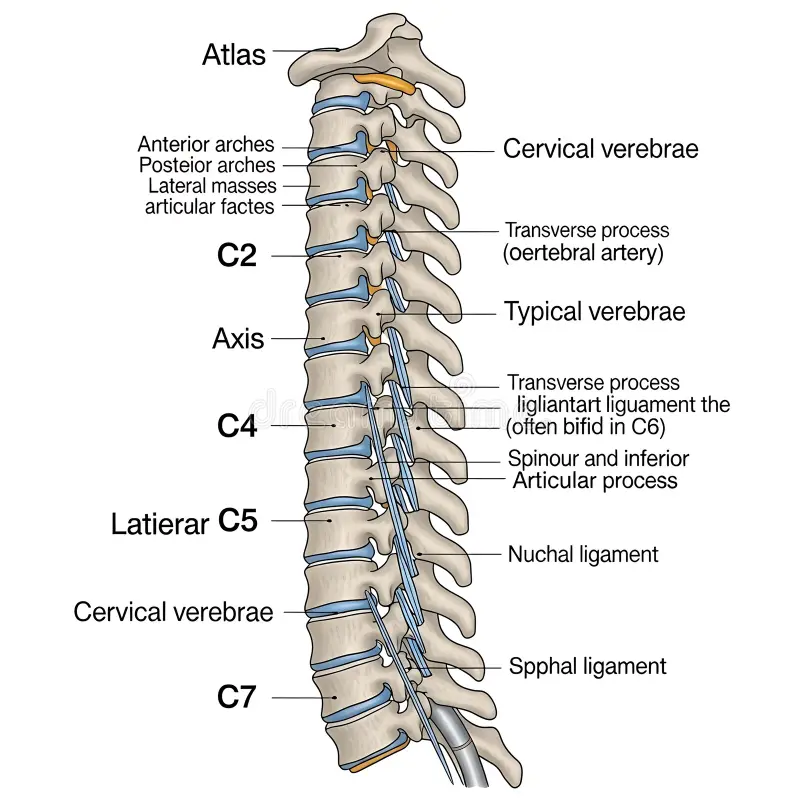
The top part of the neck is composed of two main bones: the Atlas (C1) and Axis (C2). These are connected to the skull by four pairs of suboccipital muscles. These aren’t just “movers”; they provide the brain with constant sensory information about head position. If these muscles are stressed, the “data” sent to your brain becomes corrupted.
When Systems Fail (Proprioception & Mismatch)
The joints and muscles in your upper neck are packed with receptors called mechanoreceptors and proprioceptors. These tell your brain exactly where your head is in relation to your body. This information is processed alongside input from your eyes and ears.
If there is a misalignment in the upper cervical joints, it causes chronic contraction of the suboccipital muscles. This creates a proprioceptive mismatch. When the brain receives inaccurate information from the neck, it begins to over-rely on the visual system.
This leads to:
-
Eye muscle fatigue and light sensitivity.
-
Visual disturbances in busy environments like supermarkets or train stations.
-
Restricted movement and pressure at the base of the skull.
How Top Chiropractic Can Help
So, how do we help this issue? At Top Chiropractic, we identify which of the three balance systems – eyes, ears, or neck – is the root cause. When ear tests come back “normal,” the neck is the primary suspect.
We assess the neck through two lenses: Structural Integrity and Nervous System Function. Our comprehensive diagnostic process includes:
-
Postural Observation & Range of Motion: Assessing physical restrictions.
-
NeckCare Software: Advanced testing for joint position sense and cervical control to see how biomechanics affect your neurology.
-
3D Imaging: We take precise images of the upper neck to see the exact nature of the misalignment.
By correcting the structural issue, we restore accurate signalling to the brain, helping you regain your balance and your quality of life.
If you think our approach may be right for you or if you want to find out more, why not book a complimentary 15 min call with one of our Chiropractors.