
A client came to see us a few months ago for a stiff neck, and mentioned, almost in passing, that her eyes had been bothering her for years. They felt strained by mid-afternoon and blurred slightly at the edges when she was tired. She had visited two opticians, tried three different prescriptions, and even been checked for early cataracts, yet nothing had ever shown up and nothing had changed. The comment stayed with us, not because it was unusual, but because it is one we hear more often than most people would expect.
Vision complaints rarely bring people through the door of an upper cervical practice in the first place. Headaches do. Dizziness does. A neck that will not turn properly does. Yet eyes that feel tired, vision that will not quite settle into focus, or a sensitivity to light that was not there a few years ago come up in conversation far more often than the initial reason for the visit would suggest.

Why the Neck and the Eyes Are More Connected Than Most People Realise
No single pathway fully explains this relationship, and it would be misleading to suggest otherwise. There is, however, a meaningful body of research worth setting out, since it offers a more grounded explanation than intuition alone.
The upper two vertebrae in the neck, the atlas and the axis, sit directly beneath the brainstem and differ structurally from the rest of the spine. There is no disc between the skull and the atlas, and the range of movement available at the top of the neck exceeds that of any other vertebral segment. This mobility allows for the head’s full rotation, but it also means the region carries an unusually dense concentration of muscle spindles and joint receptors, which feed information directly into the brainstem, in the same area responsible for coordinating eye movement.
This connection has measurable consequences:
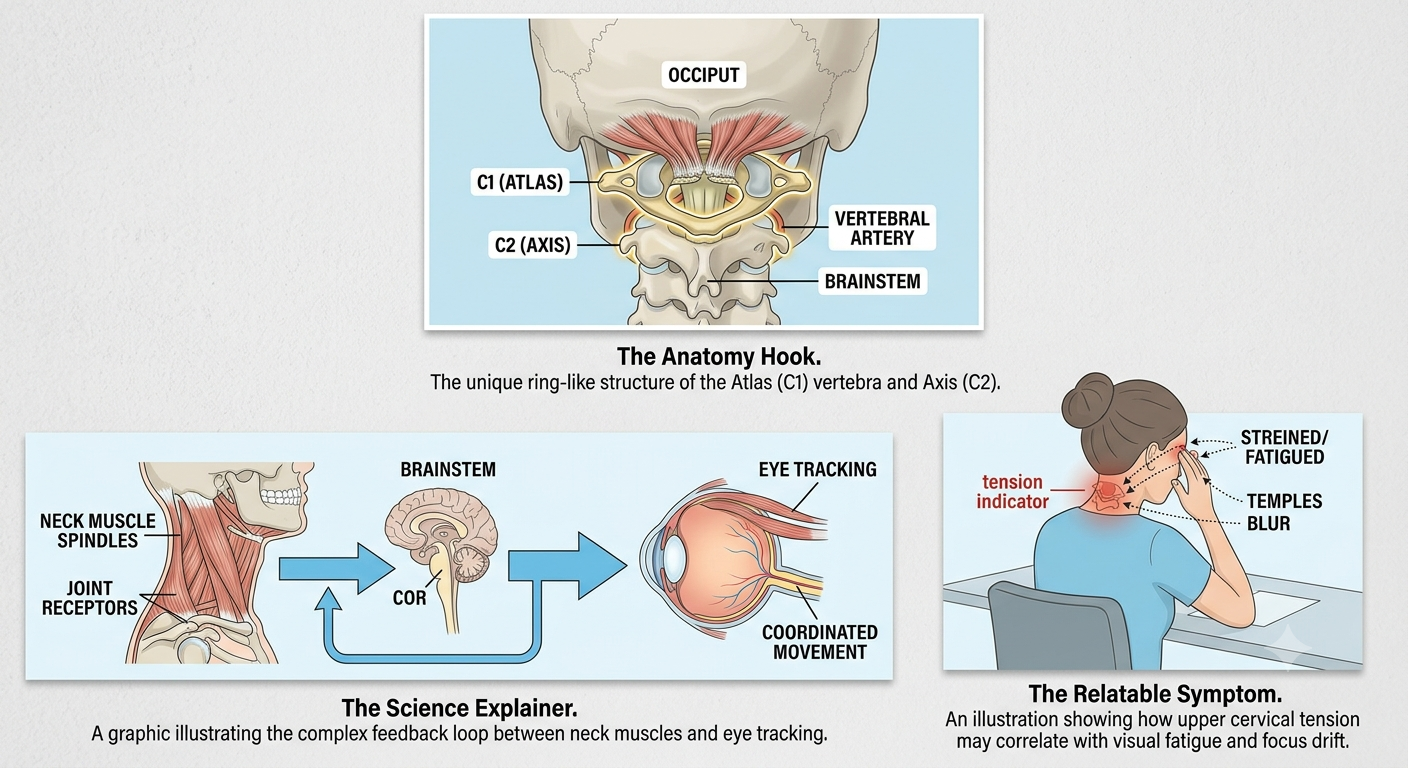
The Cervico-Ocular Reflex (COR):
This reflex moves the eyes in response to signals from receptors in the joints and deep muscles of the upper neck, rather than from the inner ear. Under normal conditions this reflex contributes very little, since the eyes rely primarily on the vestibular system and on vision itself to remain steady.
Increased Reliance on the Neck:
A 2016 study published in Physical Therapy compared individuals with ordinary, non-specific neck pain against a healthy control group. Researchers found the cervico-ocular reflex was measurably stronger in those with neck pain, while the inner-ear-driven reflex remained largely unchanged. This suggests that when the neck is under strain, the eyes draw more heavily on neck-based signals to maintain orientation, effectively compensating for changes elsewhere in the system.
Reflex Adaptability:
A separate trial conducted in Rotterdam approached the question by fitting healthy volunteers with either a rigid neck collar or having them complete twenty minutes of vigorous neck movement, before measuring how their eye-stabilising reflexes responded. In both conditions, the reflexes adapted more readily than expected, shifting according to how much the neck had recently moved or been restricted.
A further body of literature, summarised in a recent peer-reviewed case series on manual cervical adjustments and vestibular migraine, links signals from the upper neck to vestibular symptoms more broadly, drawing on clinical, experimental, and anatomical research. The authors observe that this connection is often acknowledged in passing and then dropped from clinical discussion, a fair description of where the evidence currently stands: substantial enough to merit attention, though not yet developed enough to support firm conclusions.
None of this establishes that a stiff neck causes blurred vision in any direct or predictable way. The relationship is unlikely to be so straightforward. What the research does suggest is that the upper neck and the visual system share enough physiological connection, increasingly documented through controlled study rather than observation alone, that a disturbance in one area can plausibly present as a problem in the other.

What This Tends to Look Like
People typically describe some combination of the following symptoms:
-
Fatigue: Eyes that feel strained or fatigued well before the end of the day, despite adequate lighting and no obvious overuse.
-
Blurring: Vision that blurs slightly, particularly when shifting focus between near and far distances, or later in the day.
-
Focus Drift: Difficulty maintaining focus on a page or screen, where text appears to drift rather than remain still.
-
Light Sensitivity: A new or worsening sensitivity to bright light, sometimes accompanied by headaches and sometimes occurring independently.
What stands out is what people have generally already tried: new glasses, multiple prescription changes within a short period, eye drops for dryness, screen filters, blue light glasses, or a conscious reduction in screen time. In some cases, individuals have pursued corrective surgery, only to find the underlying fatigue or blur persists once recovery is complete. When the eyes themselves continue to test as healthy, and conventional remedies are not resolving the issue, it is reasonable to consider whether a contributing factor lies elsewhere.
A Different Angle, Not a Replacement
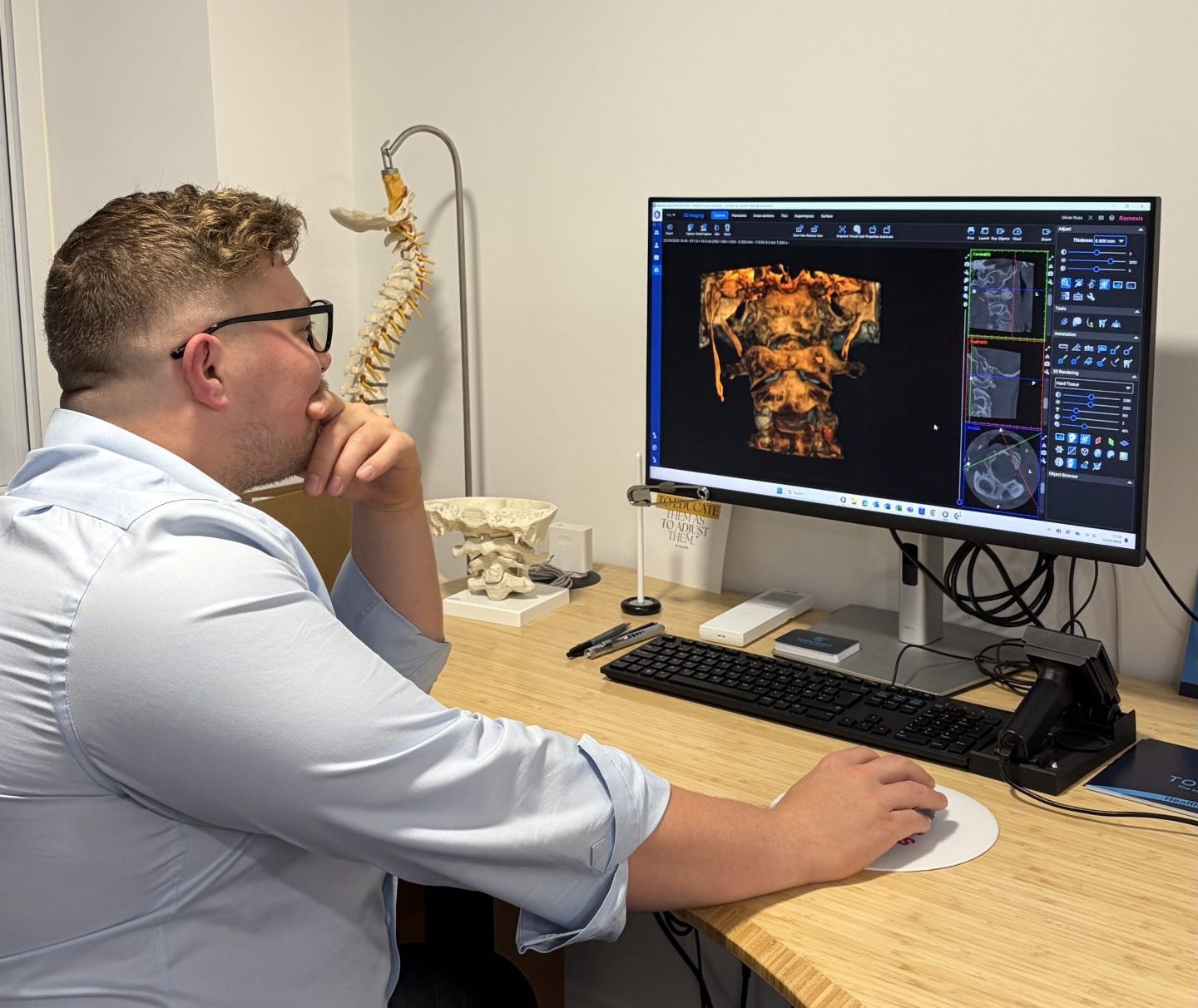
This is not a suggestion that eye care is unnecessary, nor that an optician’s guidance should be set aside. Regular eye examinations remain important, and any sudden or significant change in vision warrants proper assessment by an eye specialist in the first instance. What upper cervical chiropractic care can offer is consideration of a separate, connected aspect of the picture, particularly once the eyes themselves have been thoroughly examined and the result consistently comes back unremarkable.
The client mentioned earlier was not expecting any change in her vision when she sought care for her neck. A few weeks in, almost incidentally, she noted that she had stopped reaching for eye drops in the evening. Her vision was not discussed again after that initial conversation. She simply noticed the difference herself.
This does not constitute proof in any scientific sense, and we would not present it as such. One client’s experience is an observation, not a study. It does, however, align closely with what the cervico-ocular reflex research describes, namely the neck’s quiet influence over how the eyes behave, which makes it a pattern worth taking seriously rather than dismissing.
For anyone whose vision has been affected in ways that do not quite resolve, and where conventional approaches have not provided an answer, it may be worth having the upper cervical spine assessed alongside ongoing eye care. The full picture often only becomes clear when both are considered together.
Sources referenced:
- Treleaven J. Cervico-Ocular and Vestibulo-Ocular Reflexes in Subclinical Neck Pain and Healthy Individuals and related cervico-ocular reflex research, Physical Therapy (Oxford Academic, 2016).
- de Vries J, et al. The influence of cervical movement on eye stabilization reflexes: a randomised trial, Experimental Brain Research (Springer, 2017).
- Manual cervical therapy and vestibular migraine: A case series, peer-reviewed case series discussing upper cervical afferents and vestibular symptoms (PMC).